


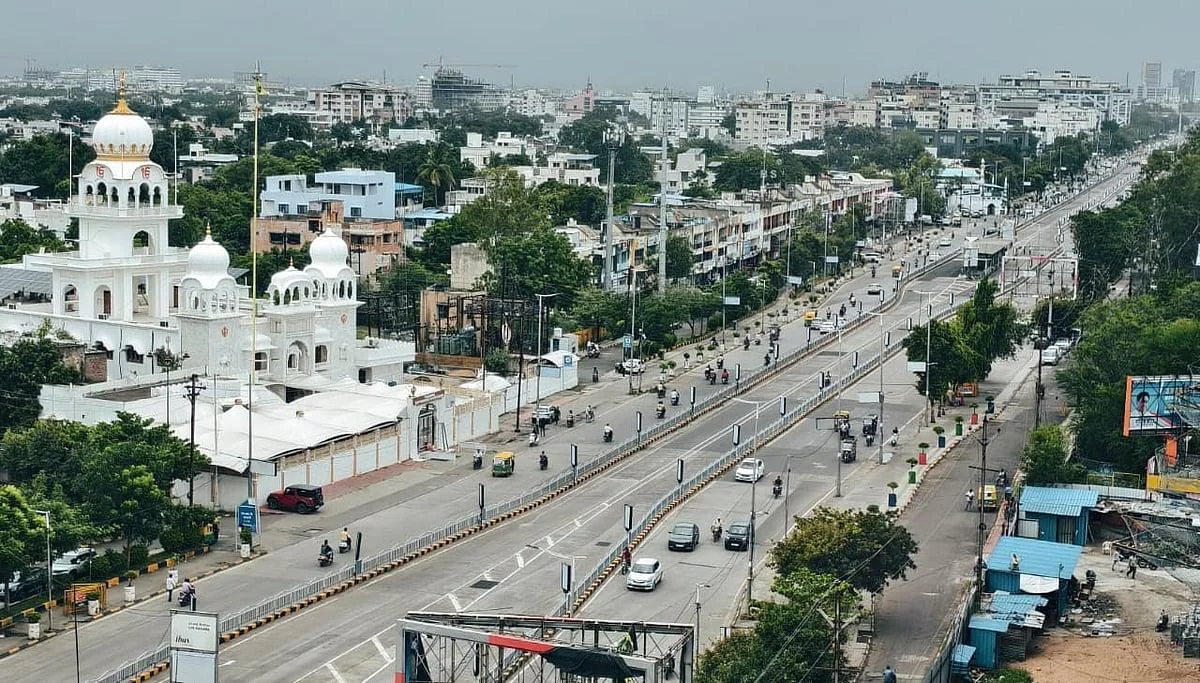
⚡ The Gist: Indore’s proposed 6-km elevated corridor from LIG to White Church Square is yet to properly begin, but barricading by the construction agency has already started affecting traffic between LIG and Palasia.
The ₹300-crore project was expected to improve connectivity, but commuters are currently experiencing the opposite reduced road space, morning and evening congestion and daily inconvenience. The situation has become serious enough for the Municipal Corporation to ask the agency to remove the barricades until actual construction activity begins.
The bigger question is not whether Indore needs infrastructure. It is whether infrastructure work should disrupt citizens before the work itself is ready to begin.
The Story
Infrastructure projects are supposed to make a city move faster. But in Indore, the proposed elevated corridor is currently creating a very different experience for commuters. The project between LIG and White Church Square is yet to properly get off the ground, but barricades have already occupied portions of the road, creating additional pressure on one of the city’s busy traffic stretches.
The proposed corridor is around six kilometres long and carries an estimated cost of ₹300 crore. According to the report, only soil testing activity is currently visible around the LIG area, while construction has not started across the rest of the proposed corridor. Despite this, metal barricades have been placed along both sides of the road, particularly affecting the section where traffic movement is already heavy.
The result is predictable. During morning and evening peak hours, commuters travelling between LIG and Palasia are facing traffic disruption and congestion. When road capacity is reduced without corresponding construction progress, the immediate cost is paid by ordinary citizens through longer travel times, additional fuel consumption, increased emissions and daily frustration.
The Municipal Corporation has reportedly asked the construction agency to remove the barricades so that traffic can move more freely until actual construction work begins. This raises a basic question about project planning: Why block public road space months before that space is actually required for construction?
The project itself has already attracted debate. A petition has been filed in the High Court questioning aspects including its utility. The report also notes that the original BRTS infrastructure on the Agra-Mumbai National Highway was demolished to make way for the elevated corridor. That history makes the current situation even more significant. A major piece of public infrastructure was removed, a new project was approved and inaugurated, yet the replacement infrastructure is still waiting to move into full-scale construction.
There is also an important planning question around the corridor’s intended benefit. A survey conducted for long-distance traffic reportedly found that only around eight percent of traffic would use the corridor from one end to the other. The project was subsequently modified to include additional arms connecting it to three major intersections.
For citizens, however, the debate is not simply about whether an elevated corridor is good or bad. Indore needs better mobility, and large infrastructure projects may be necessary as the city grows. The concern is about execution.
If a road needs to be barricaded, there should be visible and continuous construction activity behind those barricades. If work is delayed because of approvals, legal proceedings, testing or other reasons, traffic arrangements should be adjusted accordingly.
A construction barricade is not just a piece of metal. On a busy urban road, it represents lost road capacity. And when thousands of vehicles use that road every day, even a small reduction in capacity can create a much larger impact across the surrounding network.
Indore is building a city for the future. But that future cannot come at the cost of making everyday mobility unnecessarily difficult today.
🎙️ Indore Talk Take
Development should inconvenience citizens temporarily not unnecessarily. If construction has started, barricades are understandable. If construction is about to start, traffic planning is necessary. But if construction hasn’t really begun, why should the road already be paying the price?
Every unnecessary traffic jam has a hidden cost, fuel burned, hours lost, pollution increased and productivity reduced.
Indore needs ambitious infrastructure projects. But it needs something just as important: better project management.
Before blocking a road, complete the planning. Before disrupting traffic, ensure construction is ready. Before announcing deadlines, create accountability. Because a smart city isn’t one where every road is under construction.
A smart city is one where construction is planned so that the city can keep moving while it builds.